

Introduction: Chennai’s Office Market Is Changing
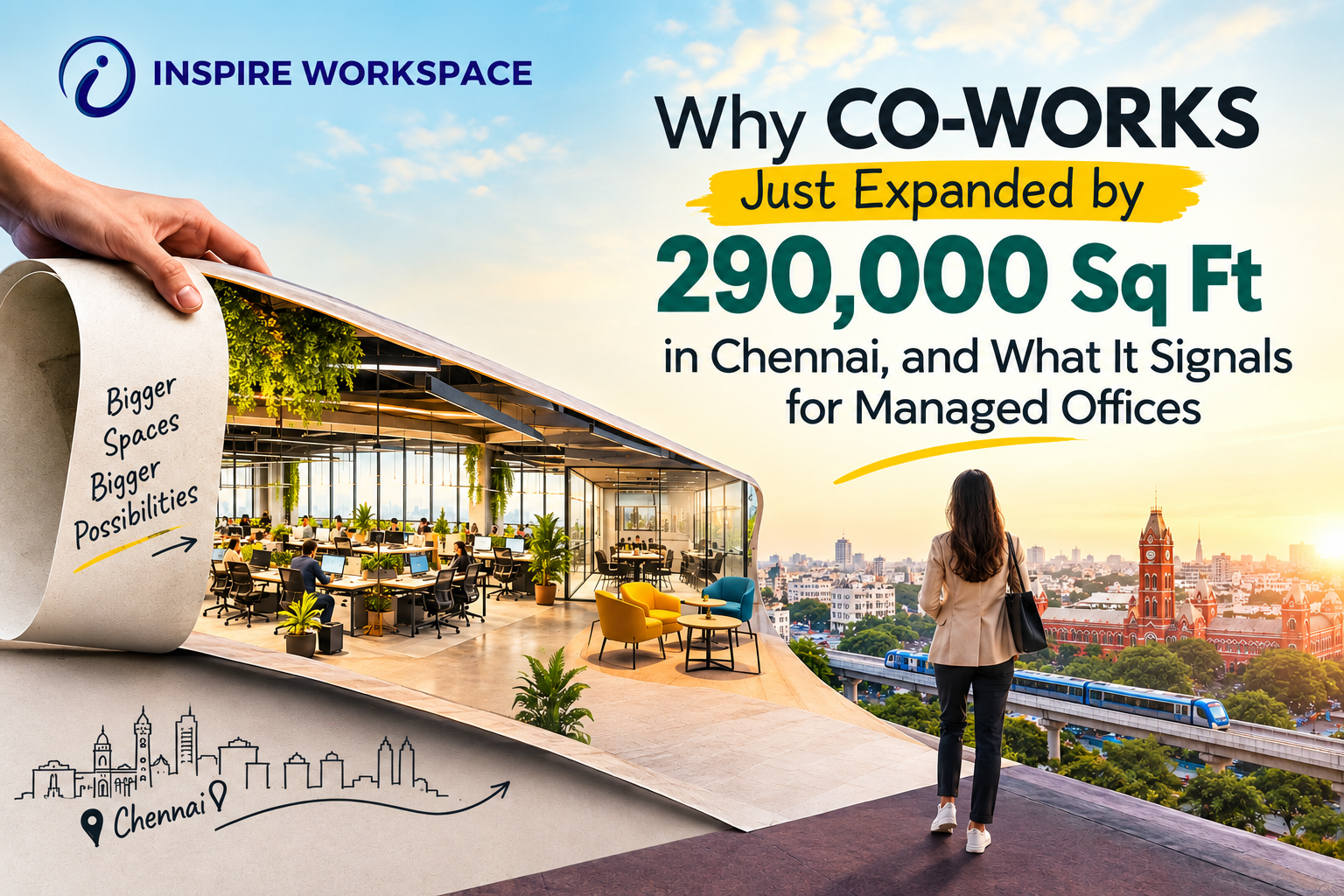
Chennai’s flexible workspace market is no longer just about freelancers looking for a desk. COWORKS, the Brook field-backed flex space operator, recently added 290,000 square feet to its Chennai footprint, which brings its total capacity to 6,800 desks. That number is significant on its own. However, the more interesting story is not the square footage but who the space is being built for.
The demand behind this expansion comes from Global Capability Centers (GCCs), enterprise teams, and growing businesses. Increasingly, these organizations want managed office environments, meaning spaces with infrastructure, flexibility, and operational support built in, so they don’t have to set up an office from scratch. This shift says a lot about where Chennai’s commercial real estate market is heading. It is also worth unpacking for any business currently weighing its office options in the city.
What Does COWORKS’ Chennai Expansion Tell Us?
1. Demand Is Moving Beyond Traditional Co-working
Co-working used to mean one thing: shared desks, shared amenities, and a flexible monthly rate aimed at freelancers, consultants, and small startup teams. That model still has a place in the market. However, it is no longer the whole picture.
As companies grow beyond ten or fifteen people, their requirements change quickly. They need dedicated work areas rather than hot desks, meeting rooms they can book reliably, and conference facilities for client presentations. They also want private cabins for leadership and confidential work, dependable IT infrastructure, and reception support that makes a good impression on visitors. Most importantly, they need to expand without renegotiating a lease every time headcount grows. Together, these needs are pushing operators to build spaces that sit between a freelancer co-working floor and a fully self-managed corporate office.
2. GCCs Are Changing the Workspace Requirement
Global Capability Centers operate very differently from individual professionals or small teams, and their workspace needs reflect that difference. Typically, GCCs require:
- larger teams accommodated within a single facility;
- private, dedicated work zones;
- robust meeting and conference infrastructure;
- a strong employee experience rather than just a functional desk;
- tighter security and controlled access;
- a professional business address that supports their brand;
- the ability to scale space up or down as headcount shifts with project cycles; and
- fast office deployment, often on tight timelines set by global leadership.
This is precisely the segment around which COWORKS has built its Chennai strategy. As a result, it offers a useful preview of where demand is concentrating across the city’s commercial property market.
Why Managed Offices Are Becoming More Relevant in Chennai
To understand why this shift matters, it helps to compare what a traditional office setup involves with what a managed office offers instead.
A traditional setup typically requires a company to find and lease a property, design and build out the interiors, and purchase furniture. It must then install IT and networking infrastructure, arrange internet and utility connections, manage ongoing maintenance, and hire dedicated facility staff. Each of these steps takes time, capital, and internal bandwidth that many growing businesses cannot spare.
A managed office, by contrast, has the workspace provider handle most of the infrastructure and day-to-day facility needs upfront. Consequently, the company can move in and start operating almost immediately, focusing on running its business rather than running a building.
Managed Office vs. Traditional Office: What Has Changed?
| Factor | Traditional Office | Managed Office |
| Interior setup | Company handles it | Ready to use |
| Furniture | Company arranges it | Usually provided |
| Office infrastructure | Self-managed | Provider-supported |
| Expansion | Can take time | More flexible |
| Meeting facilities | Separate setup | Often available |
| Facility management | Internal responsibility | Provider-supported |
| Initial setup effort | Higher | Lower |
That said, neither model is universally better. The right choice depends on a company’s timeline, budget, desired level of control over its space, and how long it realistically plans to stay in one location.
Why Chennai Is Becoming Attractive for GCCs
Chennai’s appeal to GCCs does not exist in isolation. Instead, it rests on several converging factors:
- an established IT and technology ecosystem with deep institutional knowledge;
- a large, skilled talent pool across engineering and operations;
- a growing number of global companies setting up in the city;
- strong connectivity across major business districts;
- rising demand for flexible office infrastructure among both domestic and international occupiers; and
- an expanding commercial real estate market that gives operators the confidence to invest.
As companies expand their Chennai operations, the question they ask has changed. It is no longer simply “Where can we rent an office?” but increasingly “How quickly can we get a functional office ready for our team?” This change in framing is exactly what is driving demand toward managed office formats.
What This Means for Businesses at Different Stages
- Startups typically need flexibility without the cost and complexity of a large traditional office. A managed or co-working format lets them scale their footprint as funding and headcount evolve.
- Growing SMEs often reach a point where they need private cabins, dedicated seating, and reliable access to meeting infrastructure. These needs outgrow a shared co-working floor, yet they don’t justify a full independent build-out.
- Corporate teams may require larger managed environments with more formal, professional facilities that match how they operate and how clients and partners perceive them.
- GCCs tend to need scalable infrastructure that supports larger teams and more complex operations from day one, often with very little time to get set up.
Is Co-working Still Relevant?
Yes. Moreover, co-working and managed offices are not really competing for the same customer; the market is simply becoming more segmented by need. Co-working continues to serve freelancers, consultants, small teams, entrepreneurs, and remote professionals well. Private and managed offices, on the other hand, are better suited to growing companies, larger teams, corporate operations, and GCCs that need a dedicated, controlled environment. Both models have a genuine place in Chennai’s evolving workspace landscape. The key is to match the format to where the business is now, not where it was two years ago or hopes to be in five.
What to Look for in a Managed Office in Chennai
Before committing, check the following carefully:
- flexible seat capacity that can grow with you;
- private cabins;
- dedicated meeting and conference rooms;
- reliable Wi-Fi and IT support;
- air conditioning and adequate parking;
- reception facilities that create a good first impression;
- a professional business address;
- clear options to expand within the same building or campus;
- a well-connected location;
- transparent pricing with no hidden costs; and
- infrastructure that is genuinely ready from day one, rather than “ready soon.”
Why Location Matters When Choosing an Office
Location remains one of the most overlooked factors in this decision. It affects commuting for employees, proximity to commercial and residential areas, how easily clients can visit, and overall business visibility and credibility. Vadapalani is a good example of why this matters. It is well connected to other parts of Chennai and easily accessible for both employees and clients. Therefore, it is a practical choice for businesses that need a central location without paying premium CBD rates.
Managed Office Space in Vadapalani for Growing Businesses
This is where a provider like Inspire Office Space fits in. Rather than making broad claims, it is more useful to look at the formats actually available: fully furnished offices, private cabins, co-working spaces, dedicated workstations, meeting rooms, conference rooms, virtual office solutions, and fully managed office solutions. The real value lies not in any single feature but in the flexibility to choose a format that matches where your team is today, with room to shift as your needs change.
The Bigger Signal Behind the 290,000 Sq Ft Expansion
Taking a step back, the COWORKS expansion reflects a broader change in how businesses think about office space. The question used to be simple: “I need a desk.” Increasingly, it has become: “I need an office environment that can support my team and business operations.” As a result, different workspace models can now coexist, with co-working, private offices, and larger managed environments each serving distinct needs rather than competing for the same customer.
Conclusion:
The important story is not simply the number of square feet COWORKS added. Rather, it is what the scale of the expansion reveals about Chennai’s changing workspace requirements. Companies today have more choices than ever, from co-working desks to private offices to fully managed environments. Ultimately, the right format depends on team size, operational requirements, budget, and growth plans.