




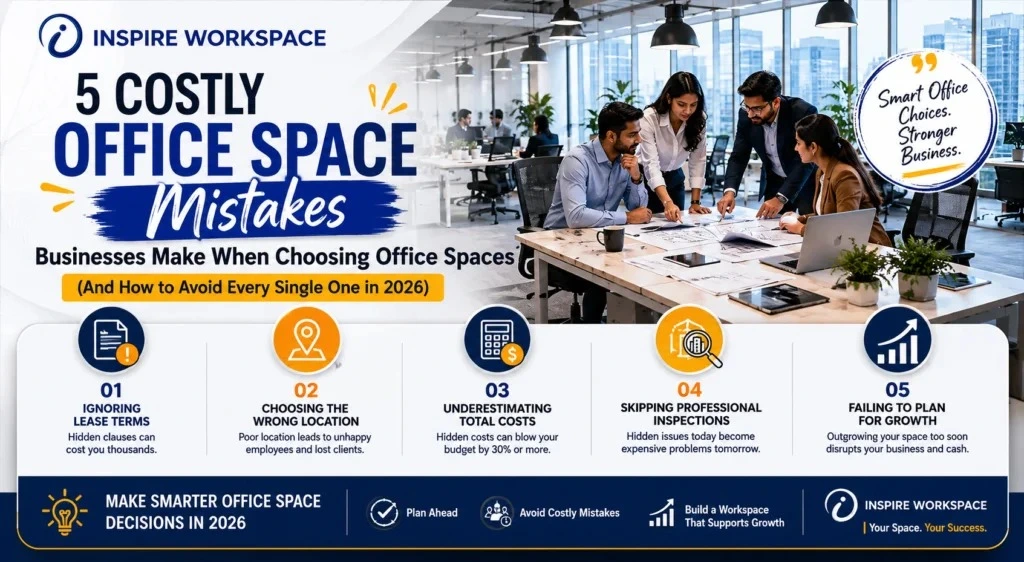
Why Office Space Decisions Break Businesses in 2026
Nobody tells a business founder that their office lease will outlast two product pivots, one rebrand, and a round of layoffs. But it happens. The workspace decision that felt perfectly rational on signing day slowly becomes a trap — one that drains cash, frustrates teams, and limits every strategic move that comes after it.
The office space mistakes covered in this article are not obvious blunders. They are the kind that look reasonable at the time. A fair rental price. A reasonably accessible location. A floor plan that fits the current team. These choices start quietly costing money only weeks or months later — by which point the lease locks everything in place.
In 2026, the Indian commercial real estate market has grown more demanding. Landlords in metros like Mumbai, Bengaluru, Hyderabad, and Delhi NCR have tightened lock-in periods. Fit-out costs have risen sharply. Hybrid work has reshaped how much space a business genuinely needs. Companies that refuse to update how they evaluate office space are paying for decisions made with 2019 thinking.
These five office space mistakes are where most of that money disappears. Here is what each one actually costs — and what smarter businesses do instead.
Mistake 1 — Rushing a Location Without Ground-Level Research
Ask any commercial property consultant what the most common office space mistake looks like, and the answer rarely changes: a business saw a listing, liked the price, and signed within a week. No site visits at rush hour. No conversation with nearby tenants. No check on whether the building had generator backup or reliable elevator service.
Location is the only variable in office real estate that no amount of money can fix after the fact. A brilliant interior fit-out cannot compensate for a building that floods every monsoon. A competitive monthly rent means nothing if three senior team members resign within six months because the commute is brutal.
What Poor Location Research Actually Costs
The financial damage from a wrong location hits in indirect ways. Hiring slows down because strong candidates rule out inconvenient addresses early. Client perception drops when your office sits in a neglected commercial zone. Productivity quietly erodes as staff spend more physical and mental energy just getting to work each day. One Bengaluru-based tech firm relocated in 2024 after discovering that their Whitefield address was being used as a reason for offer rejections by three consecutive candidates. The relocation added ₹28 lakhs in unplanned costs that year alone.
Location Research Checklist Before You Commit
- Travel to the building during peak commute hours, not on a quiet Wednesday afternoon
- Ask the building manager which tenants have vacated in the last 12 months and why
- Check flood zone maps and the building’s backup power reliability during grid cuts
- Walk a 10-minute radius and assess what your team will actually use during the day
- Run a quick survey of your current team asking how far the shortlisted office is from their homes
- Verify mobile signal strength and fibre internet availability inside the actual unit
📍 Location Reality Check — A low-rent address in a poor-access zone will cost you more in hidden productivity loss and attrition than a slightly pricier building with easy metro access. Calculate the full cost, not just the monthly rental figure.
Mistake 2 — Locking Into the Wrong Square Footage
Businesses consistently misjudge space. Some overestimate and lease a floor that echoes. Others underestimate and watch their team work with three monitors on a desk built for one. Both versions of this office space mistake are expensive — they just bleed differently.
When you lease too much, you carry dead square footage every single month. When you lease too little, the discomfort compounds. Cramped teams take longer to complete work. Collaboration gets harder because there is nowhere private to think. Eventually the business relocates ahead of schedule, absorbing costs it never planned for.
A More Honest Way to Calculate Space Requirements
Forget the generic ‘100 sq ft per person’ rule. That benchmark dates back to a full-time, five-day, office-first workforce. In 2026, your actual space requirement depends on your hybrid ratio, collaboration intensity, and how much of your team works from the same office on the same day.
Start by tracking real attendance across two weeks. Count the actual peak concurrent occupancy, not your total headcount. Most companies discover that genuine peak occupancy runs at 60–70% of total staff. That single insight alone can reduce your leased square footage by 25% without affecting anyone’s working experience.
Space Planning Numbers That Actually Work in 2026
- Open collaborative workspace: 60–75 sq ft per active workstation
- Quiet focus zones: add 15 sq ft per person for 30% of your team
- Meeting rooms: one room per 8–10 people, sized for 6 rather than maximum capacity
- Buffer for growth: add 15% only if your hiring plan is firm and funded
- Storage, server room, pantry: typically 8–12% of total net usable area
⚠️ Watch Out — Never calculate space based on your approved headcount. Calculate it based on attendance data. Approved headcount and actual daily presence are rarely the same number in a post-hybrid world.
Mistake 3 — Signing Leases Without Reading the Fine Print
A commercial lease is not a rental agreement. It is a multi-page legal instrument written largely to protect the landlord. Businesses that treat the signing process as a formality routinely discover clauses that cost them lakhs — usually during exit, during a dispute, or during an unexpected business change.
This is arguably the most financially damaging of the five office space mistakes on this list. Unlike a bad location or the wrong square footage, lease clause problems carry legal and financial penalties that are difficult to negotiate after signing.
Seven Lease Clauses That Catch Businesses Off Guard
- Escalation clause: most leases increase rent by 5–15% every 12–24 months. Always model your total cost over the full lease period, not just year one.
- Lock-in period: many commercial leases impose 24–36 month lock-in windows. Exiting early triggers penalties that can equal 3–6 months of rent.
- Reinstatement obligation: you may be legally required to return the unit to its original bare-shell condition when you leave, at your own cost.
- Common area maintenance (CAM) charges: these fees, billed on top of base rent, often add 15–25% to your true monthly cost.
- Security deposit terms: large deposits locked for the full lease term with no interest or partial release provision are common and negotiable.
- Permitted use clause: some leases restrict the type of business activity allowed in the unit. Expanding your service offering could technically breach your agreement.
- Force majeure and pandemic provisions: post-2020, these clauses matter. Check whether the lease protects you if the building becomes unusable.
What to Do Before You Sign
Hire a commercial property lawyer to review the lease — not your company’s general counsel unless they specialise in real estate. Pay for a two-hour legal review. It costs a fraction of what even a single problematic clause can trigger. Ask the landlord to clearly define all monthly charges in a written addendum attached to the main lease. Negotiate a shorter lock-in period than the default offered. In the current market, many landlords will accept 12 months rather than 36, particularly in buildings with available inventory.
📝 Non-Negotiable Rule — Never sign any commercial lease based on a landlord’s verbal assurance. If a concession or promise is not written into the signed document, it does not legally exist.
Mistake 4 — Building a Floor Plan That Quietly Kills Output
You can lease the ideal building, negotiate excellent terms, and still throttle your team’s performance with a thoughtless floor plan. Office layout is one of the most consistently underestimated office space mistakes because its cost does not show up on any invoice. It shows up as slower work, more conflict, rising absenteeism, and eventually, resignation letters.
Research from Leesman Index — one of the largest workplace effectiveness databases in the world — found that employees working in poorly designed offices are 42% less likely to describe their workplace as enabling them to work productively. That is not a marginal difference. That is nearly half your team working against their environment every day.
The Most Damaging Layout Errors in 2026 Offices
- Placing the entire team in a single open-plan space with no acoustic separation, forcing focused workers and loud collaborators to compete with each other
- Locating the leadership team in enclosed offices away from the main floor, creating a cultural and communication gap that compounds over time
- Under-provisioning meeting rooms relative to team size, leading to constant booking conflicts and informal conversations happening at desks
- Ignoring natural light distribution and placing workstations in the darkest corners of the floor plate
- Designing a kitchen or pantry area that becomes a social hub next to a quiet working zone, mixing noise sources that should be separated
What Smart Office Design Looks Like in 2026
The most productive offices built in 2026 use a zoned approach. Collaboration zones sit near the entrance where energy and noise are expected. Focused work zones sit deeper in the floor plate where distraction reduces naturally. Acoustic panels or soft partitioning separate them without building walls. Leadership desks sit within or adjacent to the main team area, not behind closed doors.
Biophilic elements — plants, natural materials, access to windows — are no longer an aesthetic choice. Multiple peer-reviewed studies now link these features to measurable reductions in stress and improvements in concentration. Even modest additions of greenery and natural light access improve reported satisfaction scores by double digits.
🔇 Noise Warning — Acoustic design is the most neglected element of Indian office fit-outs. Hard floors, glass partitions, and exposed concrete ceilings create reverberation that makes even quiet offices exhausting. Budget for acoustic panels before you budget for branding walls.
Mistake 5 — Treating Today’s Headcount as a Permanent Number
Signing a lease based on your current team size is one of the most common and most painful office space mistakes a growing business makes. The company that hires 25 people today will often employ 40 people in 18 months. The company that signs for 40 desks expecting continued growth sometimes contracts back to 22 following a funding gap or strategic reset.
Both scenarios are expensive. Both are preventable with better lease flexibility and smarter planning assumptions going in.
The Real Financial Impact of Poor Growth Planning
When businesses outgrow their space mid-lease, they typically face three options: subletting unused space from an adjacent tenant at premium short-term rates, operating split across two offices (with all the coordination cost that brings), or breaking the lease and absorbing the penalty. None of these outcomes are cheap. The average mid-lease relocation in metropolitan India now costs between ₹15 lakhs and ₹45 lakhs when all direct and indirect expenses are totalled — fit-out writeoffs, moving costs, productivity disruption, and new deposit requirements included.
Building Flexibility Into Your Office Strategy From Day One
- Negotiate a Right of First Refusal on any adjacent vacant unit in the building at the time of signing
- Choose buildings with a mix of floor sizes so scaling up means simply taking the next available unit
- Write a 12-month headcount projection alongside your lease term and stress-test both up and down scenarios
- Build a hybrid model into your spatial planning so that headcount growth does not automatically mean proportional desk growth
- Set an internal trigger point — when sustained occupancy exceeds 80% of peak capacity for four consecutive weeks, begin your next space search immediately
- Consider a managed office solution for the first 18 months if your growth trajectory is genuinely uncertain
📈 2026 Market Reality — Office leasing across India’s top 6 cities hit record volumes in 2025. Vacancy rates dropped. Landlords gained negotiating leverage. Businesses that plan their spatial strategy 18–24 months ahead are securing better terms than those responding reactively to growth.
Private Office vs Coworking Space: A Straight Comparison for 2026
| DECISION FACTOR | PRIVATE LEASED OFFICE | MANAGED / COWORKING SPACE |
| Monthly Cost Structure | Fixed rent + CAM charges | All-in flexible billing |
| Contract Commitment | 24–36 month lease typical | Monthly to 12-month terms |
| Brand & Identity Control | Full customisation possible | Limited to personalisation |
| Privacy & Security | Complete control over access | Shared building security |
| Scaling Up or Down | Costly, requires re-negotiation | Simple seat addition or removal |
| Infrastructure Responsibility | Tenant manages fit-out & ops | Operator handles everything |
| Best Suited For | Teams of 20+ with stable headcount | Early-stage or fast-changing teams |
7 Things to Verify Before You Sign Any Office Lease in 2026
- Walk the building during a working weekday. Look at elevator wait times, cleanliness, and how current tenants behave in shared spaces.
- Request the last 12 months of electricity and water bills for the unit. Irregular costs signal building management problems.
- Ask the building manager directly: how many tenants vacated in the last year, and why? Their answer tells you more than any listing description.
- Test internet connectivity inside the specific unit. Do not accept promises about building-wide fibre speed — test the actual signal in the actual space.
- Read the entire lease yourself before handing it to a lawyer. Flag every clause you do not understand. You should understand what you are signing.
- Model three scenarios before committing: your team shrinks 20%, stays flat, and grows 30%. Check whether the lease still makes financial sense in all three cases.
- Negotiate everything. Rent, lock-in period, deposit structure, CAM charges, escalation rates, and reinstatement obligations are all negotiable in the current market — but only before you sign.
Stop Losing Money to Preventable Office Space Mistakes
Office space costs rank among the top three operating expenses for most businesses. Yet the majority of companies spend more time negotiating a software subscription than they spend evaluating a three-year lease commitment worth crores of rupees.
The five office space mistakes in this article share one common thread: they all result from decisions made too quickly with too little information. A location chosen on gut feel. A space size based on today’s roster. A lease signed because the landlord seemed trustworthy. An office layout copied from a startup photo on LinkedIn. A growth plan that assumed the current team structure was permanent.
None of these are irreversible — if you catch them before signing. After signing, the options narrow quickly and the costs multiply. Treat your next office decision as the strategic business commitment it actually is. Take the time, do the research, read the full lease, and build flexibility into every agreement you sign in 2026.
Your team will spend thousands of hours in that space. The quality of that space shapes the quality of that work. It deserves serious attention.
🎯 Ready to Make a Smarter Office Decision? Use this article as your briefing document before every office viewing. Share it with your operations lead, CFO, or office manager. And before you sign anything, run it past a commercial property lawyer. One hour of legal review now is worth far more than six months of a bad lease later.nd your business — will thank you.
TO KNOW MORE ABOUT BEST OFFICE SPACE CLICK HERE