
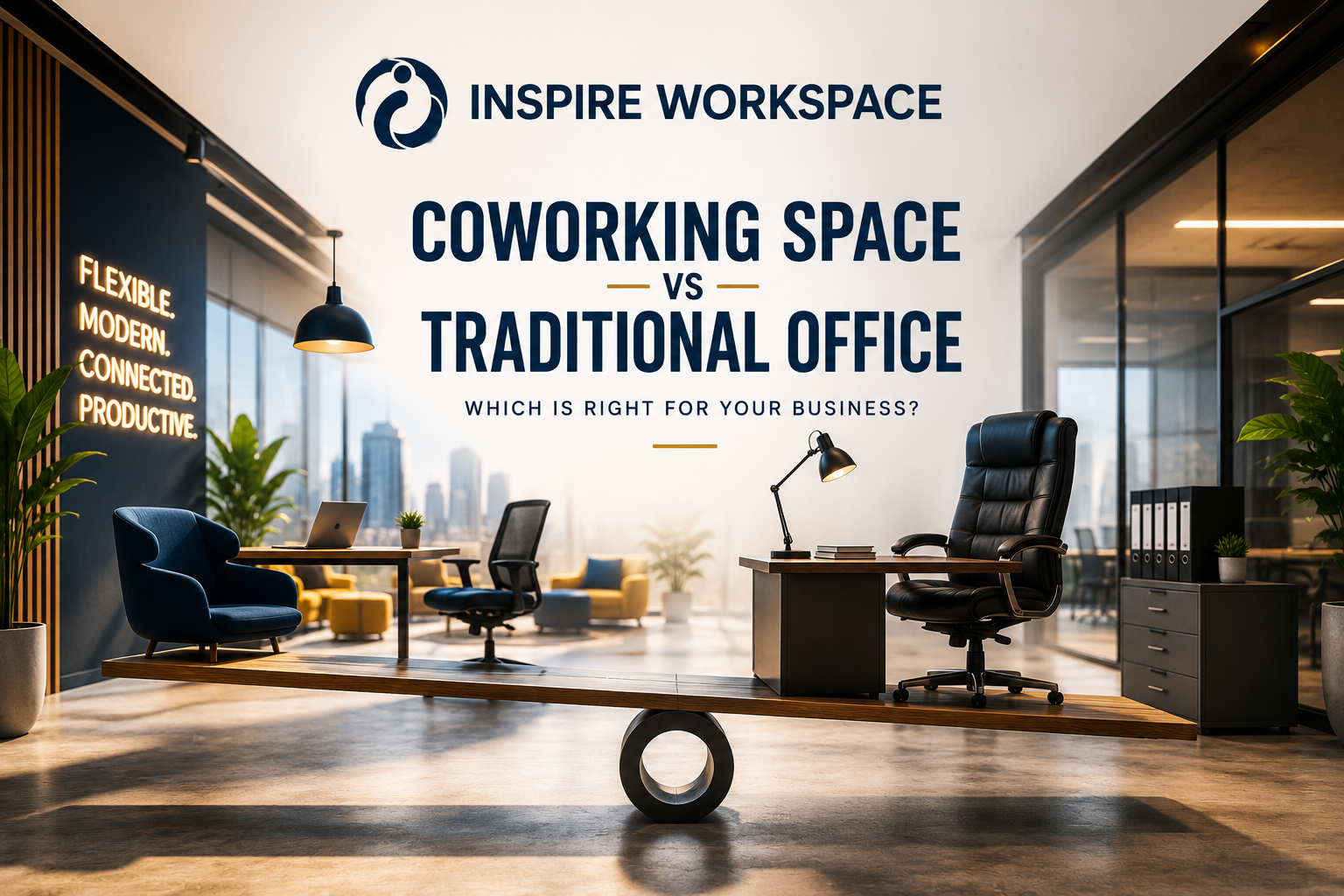
To determine which workspace delivers the greatest value, it is important to compare the benefits and limitations of each option.
Comparing both workspace solutions allows businesses to select an environment that delivers long-term value and efficiency
Let’s compare both.
What Is a Traditional Office?
A traditional office involves renting a dedicated commercial space exclusively for your business operations.
This model gives businesses complete control over office design, branding, layout, and daily operations.
Despite its advantages, a traditional office setup involves additional operational and administrative requirements, including:
Office setup and interior design
- Furniture and equipment purchases
- Utility and internet management
- Cleaning and maintenance
- Security arrangements
- Long-term lease commitments
Traditional offices are often suitable for organizations that require complete privacy, customization, and long-term operational stability.
What Is a Co-working Space?
A co-working space is a fully managed workspace where businesses can begin operations immediately without handling setup or maintenance.
Most co-working spaces typically include:
✔ Fully furnished workstations
✔ High-speed internet
✔ Meeting and conference rooms
✔ Reception support
✔ Housekeeping services
✔ Security management
✔ Utility management
As a result, businesses can dedicate more time and resources to innovation, customer engagement, and long-term growth.
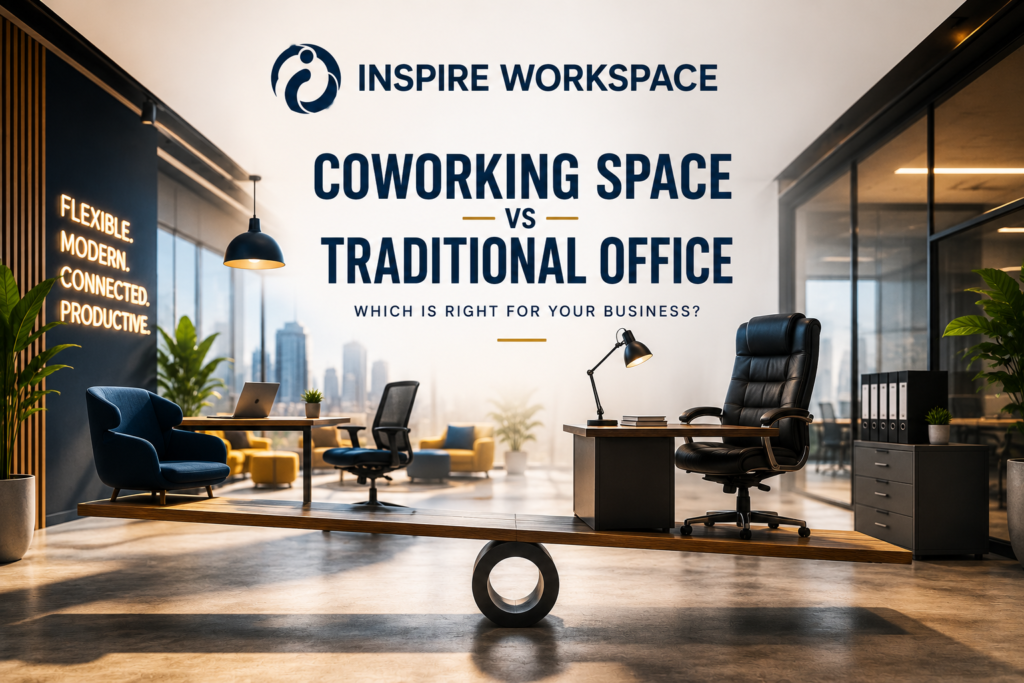
Co-working Space vs Traditional Office: Key Comparison
1. Cost Efficiency
Among all decision-making factors, cost remains one of the key considerations when choosing the right workspace
Traditional Office Costs:
- Security deposits
- Interior setup expenses
- Furniture purchases
- Utility installation charges
- Ongoing maintenance
Co-working Space Costs:
- Single monthly payment
- Minimal upfront investment
- No setup expenses
- Predictable operational costs
For startups and small businesses, co-working spaces can improve cash flow and reduce financial pressure.
2. Flexibility and Scalability
Business requirements evolve quickly.
Traditional offices often require long-term commitments and may become too large or too small as teams change.
Co-working spaces allow businesses to:
- Expand seating easily
- Upgrade office requirements quickly
- Scale operations without relocation
- Avoid long-term lease constraints
This flexibility makes co-working an attractive solution for growing businesses.
3. Professional Business Environment
A professional office environment influences how clients and partners perceive your brand.
Modern co-working spaces provide:
- Premium office interiors
- Reception areas
- Meeting rooms
- Collaborative environments
- Business-ready infrastructure
This enables companies to maintain a professional image without large capital investment.
4. Productivity and Collaboration
Workspace design directly impacts performance.
Traditional offices provide privacy and complete control.
Co-working spaces create opportunities for:
- Networking
- Business collaborations
- Knowledge sharing
- Community-driven growth
Many businesses build valuable partnerships simply by working in shared professional environments.
5. Reduced Administrative Work
Managing an office requires time and resources.
Traditional offices often involve handling:
- Maintenance issues
- Utility management
- Vendor coordination
- Internet and infrastructure support
Co-working spaces remove these operational burdens so businesses can focus on customers, projects, and growth.
Which Option Is Better?
Traditional Office may be ideal for:
✔ Large enterprises
✔ Businesses requiring complete customization
✔ Organizations needing long-term fixed operations
Co-working Space may be ideal for:
✔ Startups
✔ Freelancers
✔ Consultants
✔ Remote teams
✔ Growing businesses
✔ Small and medium enterprises
Benefits include:
- Lower operating costs
- Flexible plans
- Professional infrastructure
- Networking opportunities
- Reduced administrative workload
Conclusion
Workspaces are evolving, and businesses increasingly prioritize flexibility, efficiency, and scalability.
While traditional offices remain valuable in certain situations, co-working spaces provide a modern solution that helps businesses operate efficiently and adapt quickly to changing needs.
If you are looking for a professional workspace designed to support productivity and business growth, a co-working environment can be a practical choice.
At Inspire Office Space, businesses can access co-working spaces, private cabins, meeting rooms, and managed office solutions designed to help teams work smarter and grow faster.