

Introduction
An office can look modern without being ready for the future.
A stylish reception, designer interiors and premium furniture make a great first impression. But they don’t help much when your team doubles, your clients join meetings from three countries, or half your staff shifts to hybrid work.
Businesses today change faster than their office leases. Teams grow, technology evolves, client expectations rise, and companies enter new markets or restructure within months. In this environment, the best office isn’t the one with the most features. It’s the one that keeps supporting your business as its needs change.
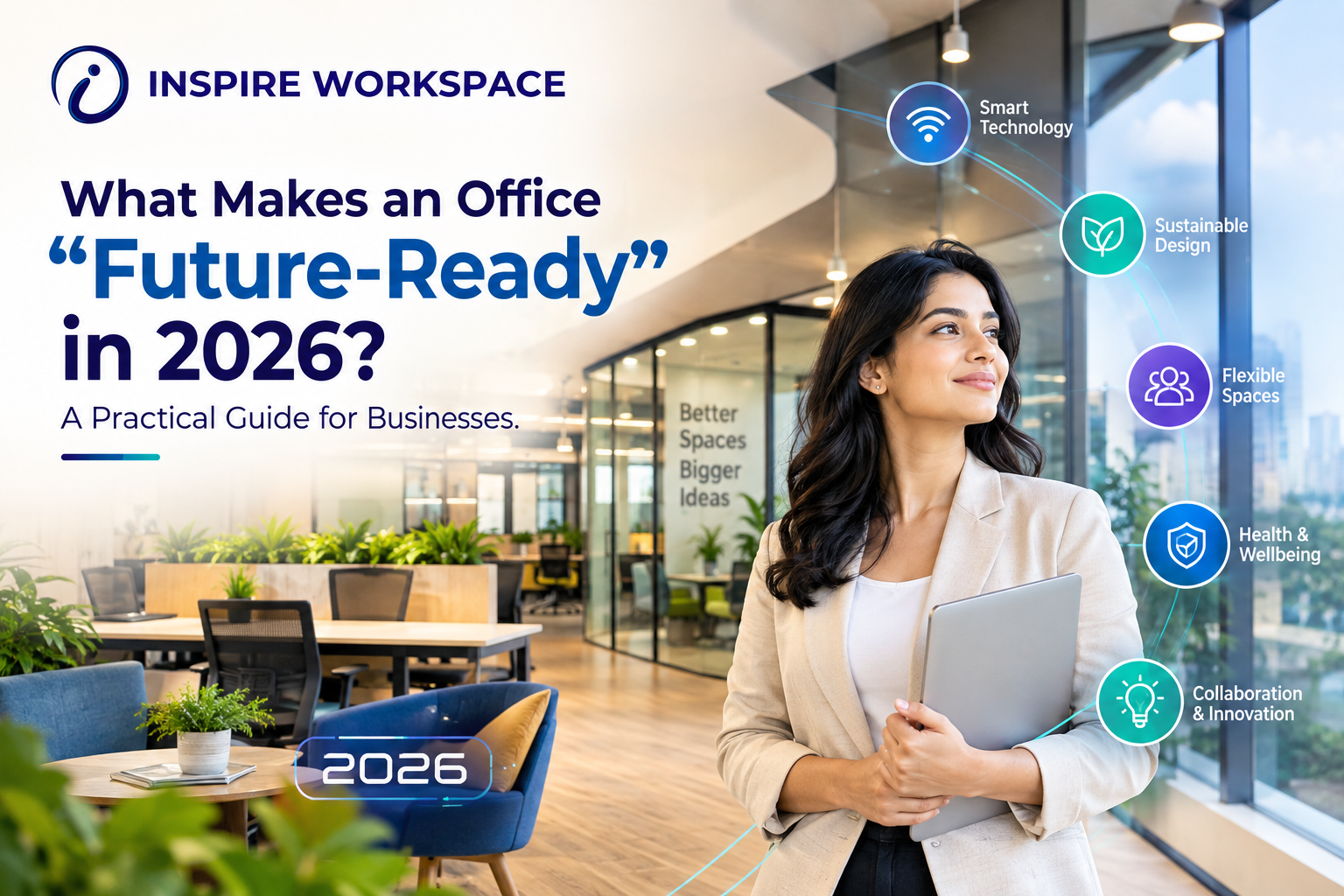
So what actually makes an office future-ready in 2026? Here are the practical factors worth evaluating before you commit to your next workplace.
1. Flexibility Built In
A company with 15 employees today may have 30 next year. A hybrid team may not need a dedicated desk for everyone, every day. A project team may need extra seats for just a few months.
A future-ready office handles these shifts without forcing a relocation. Look for:
- Flexible seating arrangements
- Private cabins and dedicated workstations
- Meeting rooms
- Expandable capacity
- Adaptable commitment terms, where appropriate
Don’t just ask, “How many seats do we need today?” Ask, “How easily can this office adapt when that number changes?”
2. Reliable Internet as Core Infrastructure
Video meetings, cloud apps, CRMs, digital payments, file sharing and cybersecurity tools all depend on connectivity. A beautiful office with unreliable internet isn’t future-ready.
Treat connectivity as essential infrastructure, and ask: what happens if the primary connection fails? Redundant connections or a dependable backup matter most for businesses that run on cloud-based operations.
3. Power Backup That Actually Works
Outages don’t just turn off lights. They interrupt meetings, drop network equipment and stall productivity. Instead of asking whether the building has a generator, ask:
- Which systems are covered by backup power?
- How quickly does it activate?
- Is internet connectivity maintained?
- How long can essential systems run?
- What happens during longer outages?
4. Meeting Rooms Built for Modern Communication
A client may join from Bengaluru, a teammate from another city, a partner from overseas. The meeting room is now part of your digital infrastructure. A good one offers video conferencing, screen sharing, clear audio, good lighting, stable internet and privacy.
The goal isn’t complicated technology. It’s meetings that are easy to start and hard to disrupt.
5. Spaces for Different Kinds of Work
Not every task needs the same environment. Financial analysis needs quiet, sales teams need collaboration, managers need privacy, and client meetings need polish. A future-ready office mixes:
- Focused areas for individual concentration
- Collaborative zones for team discussions
- Private cabins for confidential conversations
- Meeting rooms for clients and internal sessions
- Informal areas for quick chats and breaks
When people can choose the setting that fits the task, the office works harder for the
6. Technology That Solves Problems
“Smart office” is a popular phrase, but gadgets alone don’t make a workplace better. Useful technology includes easy room booking, reliable Wi-Fi, access control, visitor management, video conferencing and energy monitoring. The test is simple: does it make the workplace easier to run? If not, it’s decoration.
7. Security, Physical and Digital
Businesses handle customer data, financial records, strategies and employee information daily. A future-ready office considers both sides of security:
- Physical: controlled access, visitor management, security personnel, CCTV, secure private areas
- Digital: secure networks, access controls, reliable IT infrastructure, sound data-security practices
The office isn’t separate from your security strategy. It’s part of it.
8. Comfort Is a Productivity Issue
People spend hours in the office, and poor lighting, uncomfortable chairs, weak ventilation or constant noise take a daily toll. Practical design includes ergonomic furniture, good lighting, proper ventilation, temperature control, noise management, break areas and clean common spaces. You don’t need luxury. You need a space where people can work comfortably for long stretches.
9. Location Still Matters
Technology hasn’t made geography irrelevant. Employees commute, clients visit, candidates judge accessibility and partners attend meetings. In Chennai, proximity to public transport and major roads directly affects convenience and even recruitment, especially when staff travel from different parts of the city.
Before choosing, ask not just “Does the building look good?” but “How easy is it for the people who need to reach it?”
10. Scalability Over Excess Space
Renting far more space than you need “for growth” creates unnecessary cost. Choosing an office already at full capacity creates a different problem. The smarter path is scalable capacity: start with 15 seats, grow to 25, then 40, without a full relocation. Flexible and managed office models are built for exactly this.
11. Operationally Ready Before the Team Arrives
Traditional setups involve interiors, furniture, networking, electrical work, internet, security, cleaning and meeting-room setup, often taking months. A plug-and-play office removes much of that burden, which is a real advantage when you need to start quickly. A future-ready office is not just technologically ready. It’s operationally ready.
12. Practical Sustainability
You don’t need expensive green technology to be responsible. Energy-efficient lighting and air-conditioning, reduced paper use, waste segregation and efficient use of shared facilities all make a difference. Shared workplace infrastructure also means every company doesn’t have to build and maintain the same facilities on its own.
Privacy Shouldn’t Disappear in an Open Office
Open layouts encourage collaboration, but salary discussions, client information, interviews and management decisions need discretion. Private cabins, enclosed meeting rooms and controlled-access areas help balance openness with confidentiality.
Your Office Shapes Your Credibility
Picture a first-time client’s journey: reception, waiting area, meeting room, discussion, follow-up. Each step shapes how they see your company. This matters especially for consulting, finance, technology and agency businesses. A future-ready office supports both employee productivity and business credibility.
Look at Total Workplace Cost
Businesses are increasingly looking beyond rent. The real cost includes furniture, utilities, internet, maintenance, housekeeping, security, meeting infrastructure, administration and setup. Compare the total cost of operating the office, not rental prices alone. A managed or flexible workspace can make sense when you want to reduce the infrastructure you manage directly.
Your Future-Ready Office Checklist
| Factor | What to Check |
| Location | Employee and client accessibility |
| Internet | Speed, reliability and backup |
| Power | Backup availability and coverage |
| Seating | Current and future requirements |
| Meeting rooms | Availability and technology |
| Privacy | Cabins and enclosed rooms |
| Security | Access control and visitor management |
| Comfort | Furniture, lighting, ventilation |
| Scalability | Ability to add space |
| Setup time | How fast it becomes operational |
| Maintenance | Who handles daily issues |
| Cost | Total monthly workplace expense |
| Flexibility | Contract and expansion options |
| Client experience | Reception and meeting environment |
What “Future-Ready” Does Not Mean
A future-ready office is not necessarily the most expensive interior, the largest floor, the newest gadgets, hundreds of amenities, a fully automated workplace or a massive open-plan layout. It simply means an office that responds to changing needs without creating unnecessary friction or cost.
Modern vs. future-ready: A modern office has stylish furniture, attractive interiors, large screens and trendy design. A future-ready office adds flexibility, reliable infrastructure, scalability, security, purposeful technology, varied work environments, operational readiness and cost efficiency. The first looks modern. The second is built to stay useful.
Applying This in Chennai
If you’re searching for office space in Chennai, make future-readiness part of the selection from day one. In areas like Vadapalani, evaluate an office on more than its address:
Accessibility → Infrastructure → Flexibility → Technology → Privacy → Scalability → Total cost
Startups and SMEs can benefit from a ready-to-use managed office that offers professional infrastructure without months of build-out. Established companies can use flexible workspace for project teams, expansion teams or new business units.
Conclusion
The future of office design isn’t about predicting exactly how people will work five years from now. That’s nearly impossible. It’s about building workplaces that can adapt when those predictions turn out to be wrong.
The best office in 2026 isn’t the one with the most technology or the grandest interiors. It’s the one that gives your business room to grow, infrastructure to operate, flexibility to adapt, and an environment where people do their best work.
So when you choose your next office, go beyond “Does this look modern?” and ask: “Will this office still work for us when our business changes?” That’s the real test of a future-ready workplace.