

Introduction: Chennai’s Office Market Is Learning to Bend
Chennai’s office market doesn’t look like it used to.
Businesses today aren’t chasing the same kind of workplace at all. A large Global Capability Centre might need several hundred seats from day one. A startup might walk in needing space for five or ten people, tops. An SME might need a professional setup for 20 employees right now — and a good chunk more a year from now.
That mismatch in needs is exactly what’s fueling the rise of flexible office spaces across the city.
Instead of locking into a traditional setup — with its long planning cycles, interior work, furniture shopping, and infrastructure headaches — businesses can simply choose a ready-to-use, scalable space and get moving.
So who’s actually behind this shift?
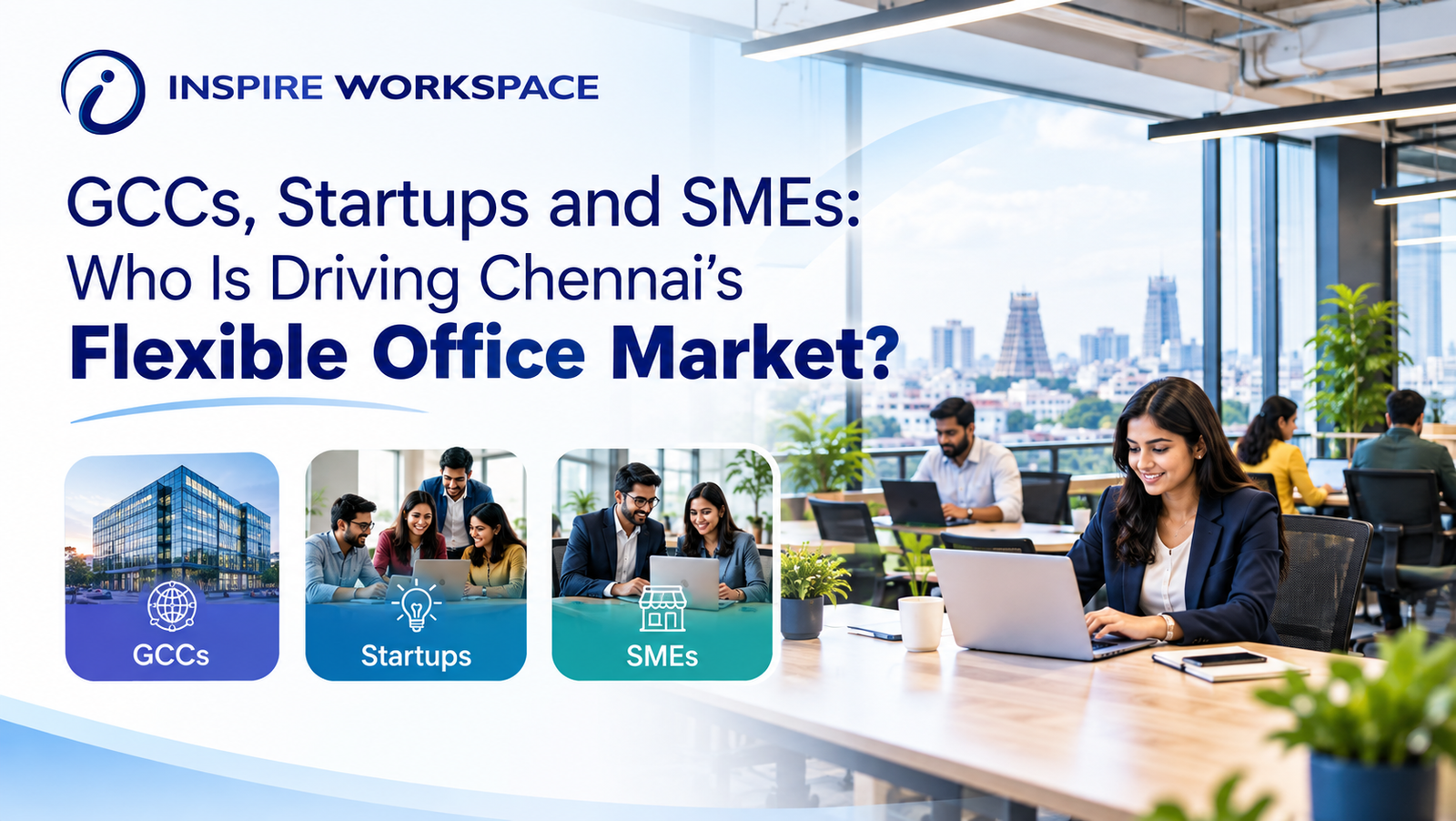
GCCs, startups, SMEs — or is it really all three at once?
1. What Does “Flexible Office Space” Actually Mean?
A flexible office lets a business choose space based on what it needs right now, instead of forcing it into a fixed, long-term setup.
Depending on the provider, that can include:
- Dedicated desks
- Private cabins
- Team offices
- Meeting rooms
- Conference rooms
- Reception area
- High-speed internet
- Power backup
- Housekeeping
- Security
- Shared facilities
The real draw here is choice. A company picks the seat count and space type that fits its current stage, and skips most of the setup work that comes with building an office from the ground up.
2. GCCs: Pushing Demand for Bigger, Scalable Spaces
Global Capability Centres have become a real force in Chennai’s commercial landscape.
Modern GCCs increasingly work across technology, engineering, product development, data analytics, finance, research and development, artificial intelligence, and digital operations.
As these teams expand, their office needs grow right along with them. A GCC might start with a small team space and, within a couple of years, need dozens or even hundreds of seats.
That kind of trajectory demands a very specific combination: scalability, solid infrastructure, privacy, and professional facilities — all at once.
For a GCC, flexibility rarely means a tiny office. It usually means being able to expand fast, without operations grinding to a halt while the physical space catches up.
3. Startups: Choosing Flexibility Over Long-Term Commitment
Startups play a different game entirely.
Headcount can shift overnight, and business plans can pivot just as fast.
A typical growth path might look like this:
5 employees → 10 employees → 25 employees → 50 employees
Locking into a large traditional office early on rarely makes financial or operational sense at that stage.
Flexible offices let startups start with exactly what they need — nothing more. They still get access to meeting rooms, a reception area, reliable internet, and a genuinely professional environment, without having to build any of it themselves.
For a startup, the appeal really comes down to three things: less setup, more flexibility, faster decisions.
4. SMEs: The Middle Ground With Growing Demand
Small and medium-sized enterprises usually want something different again.
They’ve often already built an established business and simply don’t want the hassle of managing a large traditional office.
What they’re typically after is a professional business address, somewhere between 10 and 30-plus seats, private cabins, meeting rooms for client visits, flexible rental terms, room to expand, and infrastructure that’s ready from day one.
For this segment, flexible offices strike a useful balance — a dedicated, professional space that still comes with the shared infrastructure and services you’d expect from a coworking setup.
5. Why All Three Segments Are Pushing Demand in the Same Direction
GCCs, startups, and SMEs clearly want different things. But they all agree on one point: none of them want their office to become the thing that slows their growth down.
A startup doesn’t want to relocate every time it hires a handful of new people.
An SME doesn’t want to lose months setting up a new office.
A GCC doesn’t want infrastructure delays holding back a team expansion it’s already committed to.
Put those three together, and you get real demand for workplaces that can adapt across every stage of business growth — not just one.
6. Plug-and-Play Offices Are Accelerating the Shift
A big reason flexible offices keep gaining traction is the rise of plug-and-play spaces.
A ready-to-use office wipes out most of the traditional setup process. Instead of starting with an empty commercial shell and coordinating everything separately, a business can move straight into a space that already has furniture, workstations, internet, meeting rooms, reception, air conditioning, power backup, and housekeeping sorted.
For companies working against tight expansion timelines, that head start can matter a lot more than it sounds.
7. Location Still Carries Real Weight
Flexibility isn’t only about how many seats you get. Where those seats sit matters just as much.
Employees need a commute that doesn’t wear them down, and businesses need clients and visitors to reach them without friction.
In Chennai, offices near metro stations, major roads, public transport, residential neighbourhoods, and everyday essentials like restaurants tend to pull ahead as the more attractive choice for growing companies.
For businesses hiring talent from across the city, that kind of accessibility can shape employee experience — and even how often people actually show up.
8. Hybrid Work Keeps Adding New Layers to the Demand
Hybrid working has changed how companies think about office capacity altogether.
Not every employee needs a permanently assigned desk anymore. Instead, businesses increasingly want a mix — workstations, collaboration areas, meeting rooms, private spaces, training rooms, and flexible seating, combined in whatever ratio actually fits how their people work.
That lets a company build its workplace around real usage patterns, rather than guessing. And flexible office providers are well placed to deliver exactly that kind of adaptable setup.
9. GCCs vs. Startups vs. SMEs: What Each Segment Actually Needs
| Business Type | Typical Requirement | Main Priority |
| GCCs | Larger team spaces | Scalability and infrastructure |
| Startups | Small to medium spaces | Flexibility and cost control |
| SMEs | Private or team offices | Professional setup and convenience |
None of these categories stay fixed, though.
A startup can grow into an SME. An SME can grow into a much larger organisation. A GCC can start with a handful of people and expand rapidly within a year or two.
That constant movement is exactly why scalable office solutions matter as much as they do right now.
10. What Businesses Are Actually Looking for in 2026
Across all three segments, a handful of priorities keep showing up again and again.
Flexible space — the ability to choose exactly what fits current needs, without overcommitting.
Ready-to-use infrastructure — skipping the long, drawn-out setup process entirely.
A professional environment — private offices, meeting rooms, a proper reception, and interiors that actually feel considered, for both employees and clients.
Reliable connectivity — fast internet and dependable power, treated as a baseline rather than a bonus.
Scalability — room to add seats or space the moment growth demands it.
Convenient locations — easy access for both employees and clients, without it becoming a daily source of friction.
11. Is Any Single Segment Really Driving the Market?
Honestly, no single answer covers it.
GCCs are pushing demand for larger, more scalable office environments. Startups are driving demand for flexible, low-commitment workspace models. SMEs are creating demand for professional, ready-to-use team offices.
Together, all three are quietly reshaping Chennai’s flexible office market from different directions at once.
The real shift isn’t just about who’s renting space anymore. It’s about how businesses actually want to rent and use it.
12. What This Means for Chennai’s Office Market Going Forward
As more businesses grow comfortable with flexible workplace models, office providers will likely need to offer a lot more than just desks and chairs.
Expect the future workplace to lean harder into:
- Scalable seating options
- Private team environments
- Technology-enabled offices
- Meeting and collaboration facilities
- Flexible rental models
- Ready-to-move spaces
- A stronger employee experience
- Genuinely convenient locations
That shift should make Chennai’s office market a lot more diverse — giving businesses real choices based on their size, industry, and growth plans, rather than a one-size-fits-all setup.
Conclusion: Flexibility Is Becoming the Common Ground
GCCs, startups, and SMEs run very different playbooks, but somehow they’re all pushing Chennai’s office market in the same direction.
Toward flexibility.
GCCs want room to scale. Startups want room to experiment and grow without penalty. SMEs want a professional space without unnecessary setup complexity standing in the way.
That shared pull is exactly why flexible office spaces are becoming such an important part of Chennai’s commercial real estate story.
The future probably isn’t about choosing between a traditional office and a coworking space at all.
It’s about finding a workplace that fits the business today — and can genuinely keep up with it tomorrow.