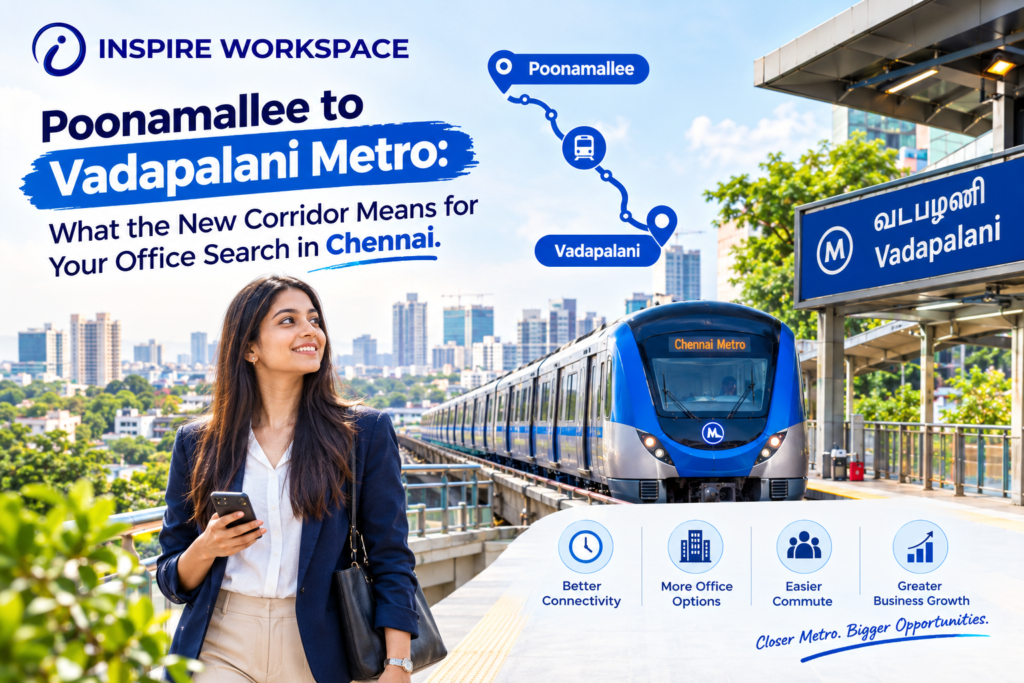
Poonamallee to Vadapalani Metro: What the New Corridor Means for Your Office Search in Chennai
Introduction Ask anyone who commutes across western Chennai, and they’ll tell you the same thing: the journey is often longer than the distance suggests. Traffic on Poonamallee High Road, the Porur junction and the roads leading into Vadapalani can turn a short trip into a long one. That’s why the new Poonamallee to Vadapalani Metro corridor is such welcome news. The Phase II stretch covers roughly 14.64 km and has 11 operational stations connecting Poonamallee Bypass to Vadapalani. It opened to passengers on October 11, 2026, according to The Times of India. But the impact goes beyond daily travel. When getting to work becomes easier, businesses start asking different questions. Where will our team find it simplest to commute? Which neighbourhood is easiest for clients to reach? Is it time to rethink our current office? If you’re exploring office space in Vadapalani, Chennai, this is a good time to take a fresh look at the area. In this guide, we’ll cover what the new metro line changes, why Vadapalani deserves attention, how to choose between co-working, private cabins and managed offices, and what to check before you sign anything. What’s actually new on this route? The line links residential and fast-growing neighbourhoods such as Poonamallee, Kattupakkam, Ayyappanthangal and Porur directly to Vadapalani. The 11 stations are: For anyone living along this belt, there’s now a way to reach Vadapalani without depending entirely on the road. Timings can change in the early weeks of a new line, so check Chennai Metro Rail Limited’s official updates before planning your routine. DT Next has covered the launch schedule. For employers, the question gets simple: how easily can my team get to work? Why Vadapalani is worth a second look Vadapalani isn’t a new business address. It’s an established part of Chennai with shops, restaurants, transport links, residential neighbourhoods and plenty of business services nearby. The metro connection adds one more reason to consider it, especially if your team or customers come from the west of the city. It’s easier on your team. Not everyone wants to drive or ride every day. If you’re hiring from several parts of Chennai, a metro-accessible office is a useful selling point. Real travel time will still depend on where someone lives, which station they use and how far that station is from your door. It works for growing teams. Startups and small businesses need more than desks. They need a professional setting, meeting rooms and infrastructure that can grow with them. Vadapalani gives you an established location to weigh against your budget and your team’s commute patterns. The surroundings matter more than people think. A good lunch spot, a quick errand run, easy transport for a visiting client: these small things shape how an office feels. When you visit a building, walk the area as well. How metro access can shape your office decision Choosing an office used to be about finding the biggest space you could afford. Now it’s also about flexibility, employee convenience and running costs. The new corridor adds one more factor to weigh. A metro line won’t guarantee growth or rising property values on its own. It’s one practical factor among several. Co-working, private cabin or managed office? The right choice depends on team size, how much privacy you need, your budget and how fast you expect to grow. Co-working space. Good for freelancers, consultants and small teams. You get a workstation, internet and shared facilities without running an office yourself. Private cabin. A good fit for startups and small companies that need a dedicated space for focused work, internal discussions and client conversations, with more privacy than an open floor. Managed office. If you want a dedicated setup but don’t want to handle every detail of fit-out and upkeep, this takes much of that off your plate. Meeting room. Remote or flexible teams often only need a professional space now and then, for client presentations, interviews or reviews. Renting a room by the hour or day can be enough. Before you rent near Vadapalani Metro: a quick checklist Being close to a station helps, but don’t let it make the decision for you. Check these first: The best office isn’t just the one nearest a station. It’s the one where location, facilities, cost and working environment fit together. Where Inspire Office Space fits in If you’re looking for a professional workspace in the area, Inspire Office Space in Vadapalani is one option to consider. It’s located near Vadapalani Metro, opposite Nexus Forum Mall, and offers: Whether you’re a startup hiring your first team, a consultant who needs a place to meet clients or an established business rethinking its space, the best starting point is how your team actually works. If some of your people travel in from western Chennai, the new metro line is a good reason to compare your commuting options. Before you visit, confirm the exact distance from the nearest station, current availability, facilities and commercial terms. Looking ahead As Chennai’s public transport network expands, ease of access will keep influencing where businesses choose to settle. Over time, commuter habits may change how companies compare different commercial neighbourhoods. The smart approach is to look past the building itself and think about the whole experience: the commute, the infrastructure, your team’s convenience, client access and flexibility. Conclusion The Poonamallee to Vadapalani Metro corridor is a meaningful step for western Chennai. It gives commuters a new way to travel and gives businesses a fresh reason to rethink where they work. Choosing an office in Vadapalani takes more than being close to a station. Think about the type of workspace, the facilities, the terms and what your day-to-day operations need. Looking for office space in Vadapalani, Chennai?Explore co-working spaces, private cabins, managed offices and meeting rooms at Inspire Office Space. Visit https://inspireofficespaces.com/ to see the options and share your requirements